Steph is feeling kinda down. Air Canada gave her the royal screw with her vacation plans. I hope it's been resolved, but last night Steph was seriously down.
To cheer her up, I told Steph to open Google Maps and randomly pick three places on a map of Toronto. I'd visit those places on my errands today and photoblog them.
Why? Cause it's collaborative content development. Also because I love exploring this city and driving my car (which, thanks to a much better service department at a new dealership, has a clean bill of health!)
So here's where Steph sent me:
DESTINATION #1: BAMBURGH CIRCLE (WARDEN AND STEELES)
DESTINATION #2: QUEEN ST. EAST AND BROADVIEW
DESTINATION #3: GALLERIA SHOPPING CENTRE AT DUFFERIN AND DUPONT
Ok, DESTINATION #1: BAMBURGH
Driving to Bamburgh form my place at Yonge and Eg, I took Lawrence and made a stop at Arz Food, this amazing Middle Eastern grocery store with fantastic prepared foods, baklawa, and fresh pitas. Among Toronto neighbouroods, the section of Lawrence between Vic Park and Warden is refered to as the 'Gaza Strip' because of the concentration of Middle Eastern food stores and businesses there.
Driving up Warden from Lawrence I'm in a low density, semi-industrial row of vacant commercial buildings below the train tracks. There's this superboard for Advertising Week (held in late January in Toronto). It seems that the locations for Advertising Week superboards are in the most bizarre locations. Purposeful? Meant to be thought-provoking for marketers, the target audience?
Arrival at Bamburgh. It's a nice residential street with two story suburb homes on one side and tall condo towers in an enclave on the other side.
I know this isn't the first picture someone took of a suburb with a 'no exit' sign...
Onto DESTINATION #2!, QUEEN ST. EAST AND BROADVIEW
Speeding down the DVP. It really is a beautiful roadway when it moves. I like it when it winds and twists south of Eglinton. It feels great to hug the car along the turns of the road as you see the city materialize before you through trees and cuts between buildings.
Queen East at Broadview is Leslieville, a rapidly developing neighbourhood in transition. It's a commercial strip with old world delis, new world espresso bars, chocolate shops, and art galleries.
It's also got a lot of homeless and street kids walking up and down the sidewalk competing for space with the tandem strollers, joggers, and seniors. Truly a mixed neighbourhood.
Really nice neighbourhood for a Saturday afternoon stroll (thanks Steph, this was really one of my favourites!). Thinking of moving here.
Unfortunately I got a parking ticket as I was getting a corned beef sandwich from a Polish deli. Steph, you owe me $30.
Onto DESTINATION #3: DUFFERIN AND DUPONT
I drove along Queen past City Hall
...up through Koreatown
...and along Dupont to get here, and I parked in this messy parking lot for a low-rent shopping mall, the Galleria centre. It's a multi-ethnic, mixed-use, low-income neighbourhood.
It's showing its age too. The whole places looks like a transplant from the 1960s/70s.
This isn't a tough neighbourhood, it's just ugly. Ugly for the grey and brown buildings and enormous expanses of cracked concrete roads.

By this point I was exhausted and going crazy from the other drivers, but I look up, and there, on top of a car wash, was another sign for Advertising Week. Part of me smirked knowing that I was potentially in on an in-joke.
Saturday, February 14, 2009
Photoblogging random Toronto neighbourhoods


Saturday, October 18, 2008
Consumers beware of scary marketing
Journalism can sometimes sound really terrifying and kinda miss the point. It's like so many Republican spin masters and commentators being interviewed on AC 360 recently who are making these pronouncements like the US Congress needs a thorough evaluation, constituent by constituent to determine who is pro-American and who is anti-American.
Really....?...REALLY.......? This matters now?
Now, I like CityNews. I think it's a good local news platform and the broadcast is definitely exciting, entertaining, and hopefully relatively unbiased and informative. It's always had sensationalist news stories, 'Find out which foods you're eating right now are killing you...after the break!' or 'Is the TTC killing you?' or 'Why Ontario's education system wants to kill your kids!' - I just made these up, but are they really too far-fetched? lol.
However, a recent piece on the website by Michael Talbot, 'Have advertisers gone too far?', makes it clear to me now that their online platform has wholly mirrored their television broadcast for devoting attention to eye-catching but paper-thin news stories.
Citing examples of obnoxious, out-of-home, experiential advertising (including Boston's video box scandal and SMS campaigns coinciding with the launch of Dexter's new season), Talbot asserts that advertisers (no Michael, they're marketers who dreamed these up...) have "delved into shady realms" and are engaging in sinister tactics to "pry your hard earned money away."
Um...what?
So I'm in this profession because I like to sell people things they don't need and I want to impoverish them?
Of course what's not being emphasized is the considerable new value that consumers are realizing in marcoms that are relevant and meaningful to them - value derived from new technology that can touch the consumer on a one-to-one basis. And consumers are responding! There's a reason why viral, P2P, guerrilla, and SMS are done - it's because (if done well) they are effective platforms for creating buzz and awareness. The interactive forms are also strong mediums to enhance consumer relationships with brands. So why is this so scary?
Evaluate the news a little more critically - that goes for you too Michael Talbot.
(i just think this is a funny picture!)


Wednesday, September 10, 2008
Zig and bumvertising: Bad ad rodeo
It's been a while since I've written another Bad Ad Rodeo, an analysis of awful ads that fail to inspire - but this one is juicy!
It’s called bumvertising, an offensive and ridiculous new invention by marketers (Zig Interactive here in Toronto) as a way to be tongue-in-cheek and promote a client’s socially critical message using socially distasteful means. Homeless people in Toronto have been paid $250 per day to sit with signs for CFRB talk radio and act as human billboards. We’ll talk about whether this is good marketing or not later, but it’s so transparently lacking in basic values that I’m inclined to say no matter how effective a campaign this was, it has really done our business and the client a disservice because of the general tone and reception of the campaign. Click the image to read larger.
There really wasn’t a better way to get the message across while still keeping your chins up? Are the CDs at Zig actually proud of the social discourse that they’ve catalyzed in Toronto about the homeless? How about whether they’re proud to call themselves marketers? I can certainly appreciate why observers might now have a bitter taste about our profession when this schlock can now act as a focal point for all the negative perceptions people have about ad men.
‘They are immoral’
‘They sell me things I don’t need’
‘They don’t care where the message is as long as someone sees it’
Bumvertising and Zig Interactive have done nothing to advance the state of marketing in Canada. There’s no differentiation or evolution of ideas from good to great. This isn’t great marketing…it’s just a sleazy shill for a client.
…and that’s another thing. If this was a campaign actioned at the client’s request, didn’t someone at Zig have enough of a spine to take a stand and express their dissatisfaction with how the agency might be selling its soul for CFRB?
But I guess the campaign might have actually been effective. Think about it. High-traffic locations, unique context, appropriate message, “should panhandling be illegal?” It’s hit the checklist of effective out-of-home campaigns, and it seems to have created a good buzz. You’d be hard pressed to find someone who does not have an opinion on this campaign or doesn’t show some sort of emotion when learning about it. It was likely also cost effective – I’m guessing $30K, including creative development and street execution?
But is that what the homeless are now in our downtown streets? Marketing campaign executioners?
I’m really disappointed in Zig and CFRB. Someone should have had the common sense to stand up amidst the back-slapping, hand-shaking, and self-congratulatory praise for developing such an “innovative, thought-provoking, and socially stimulating campaign” to say that while it may have been all of those things, it falls down on basic marketing morals and human decency.
Grade: F
Tuesday, September 2, 2008
Cool interactive billboards and 90210
Interactive media is where it’s at these days in terms of delivering excitement and experience to consumers. Often though, the message is gets lost in the punchiness of the medium. The channel distributor has done a great job selling ad space and gross consumer impressions to unsuspecting, wide-eyed brand managers that the issue of whether or not the marketing is effective or not is never raised.
Such might have been the case for an interactive billboard I experienced a few weekends ago at the Harbourfront Hot and Spicy Food Festival. Watch the video, it’s a 6 x 8 foot led screen which is touch-sensitive. As people step and tap on it, colourful led balls go flying around the screen. It’s wild. My friend Olga took the video as we played around.
…but what was it advertising again? What brand was there?
I’m not saying that this was an ineffective vehicle – far from it. We stood there giggling and jumping around on this led mat for probably ten minutes. People around us joined in. So the audience is tuned in and captive, they’re rapt by what they’re seeing and the fact that they have control over the ad itself is a big plus. As mentioned before in this blog, participation is a critical factor in modern marketing, especially in an ad targeted to Gen Ys. It afford a modicum of individualization and personal spin on the marketing, making the consumer feel like they have accountability over the marketing. This, in turn, makes the consumer feel that the ad has greater relevance to them (because they created it or had a part in it).
Adverblog talks about some of the better interactive online marketing campaigns. It’s interesting in all of these to see how prominently the brand and product are featured. It’s never unclear what is being explained.
So as for that wild led screen, perhaps its use is better for promotional settings where you can physically interact with the brand. Imagine Nike setting up two of these in stores and allowing consumers to try out the shoes as if they were a soccer goalie or seeing how high they can jump in the shoes. Imagine these displays in high-traffic locations like the PATH system and each step displays the kinetic energy created – a potential ad for Bullfrog or Bruce Power looking to promote their clean energy options to consumers.
Anyway, some food for thought. The new series of 90210 just started, featuring AnnaLynne McCord:
…and yes, bad television counts as legitimate research into consumer culture.

Wednesday, July 30, 2008
Awful vehicle wrapping
I'll post later today, but this just irked me so much that I had to blog about it.
Vehicle wrapping - putting big decals on the body panels of cars as a form of mobile advertising - is not a particularly innovative or interesting marketing technique. It's ubiquitous in downtown cores so unless it's particularly eye-catching, the message can fade into the white noise of other out-of-home mediums.
But today at Yonge and King, a 2008 Jaguar XK coupe turned in front of me. Ordinarily it should look like this:
...but it was wrapped with the branding for some firm 'Portilly' or 'Portally' firm and the car looked like this:
Barf. Wrapping has its place, but not on gorgeous cars like a Jaguar. It's like putting a supermodel in flats or a famous painting in a garish frame. Why not take just a pickaxe and strike a few speedholes in the hood while they're at it.
Why is this bad? Because it's offensive. It's offensive to good taste and good judgment. Leave vehicle wrapping for hideous rides like PT Cruisers, Beetles, and Priuses.
Saturday, July 19, 2008
Creative spaces for creative faces
 Marketing culture is unique in many respects. In the workplace, there’s a high need for interactivity and stimulation to catalyze innovation. Additionally, the multi-team collaboration required on client projects means that openness and team participation must be cultivated. Style wise, this translates to open-form offices, lots of public spaces or ‘idea rooms’, and a design aesthetic that often runs the gamut between edgy and exposed or frosted and futuristic. In Toronto, the head offices of Cossette or Capital C might be good examples of the former while Wunderman is a good example of the latter.
Of course, it would be nice to have a space like this for B!G and not have to work out of the dark basement of the Schulich building, but as we’re a non-profit, I’m happy for whatever we can get! I am saying all this because today I stumbled across a really amazing workspace downtown, called 401 Richmond. This is a converted 1899 factory that has been restored and now houses about sixty arts and media related tenants, including ad shops. Creaky wood floors, 15 foot ceilings, and big open windows invite casual passers-by and tourists into the 401 to walk through the floors and see the boutiques and bookstores. On top of the building is a beautiful flower-filled roof garden with terrific views over the neighbourhood and downtown core. But really, it’s a space for artists with working studios and galleries side by side.
Thrown into the mix are a few small boutique media and marketing shops (Boxx3G, Agito Internet Marketing , and Meta Strategies. I can appreciate why these companies would want to set up business next to artists and creatives. Not only is the building beautiful and occupies a fantastic site in downtown Toronto, but it’s also the model of the agency interior design taken to a larger, macro level. Idea diffusion and new visioning among creative heads is far quicker and clearer when you’re working next to each other. Think of this like a perpetual motion machine that moves faster and faster, it’s the same reason why research universities and technology firms always seem to be grouped together (e.g. Stanford, MIT, UNC Chapel Hill). Innovation spreads faster when the relationships among individuals and firms are mercurial and proximate.
You cannot be creative if you’re in an artistic and cultural vacuum. Agencies should learn from examples like 401 Richmond and internalize this to mean not just sleek, sexy desks with exposed brick walls, but also collocation with artistic people who will inspire and tickle the imaginations of their creative employees.
Friday, June 27, 2008
Toronto's urban landscape
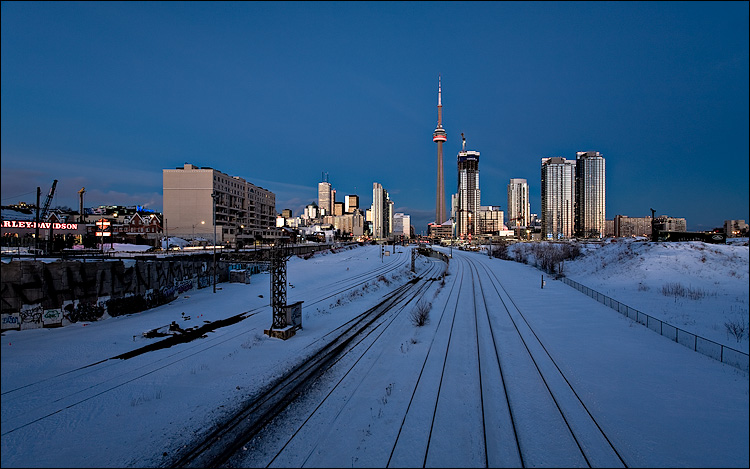
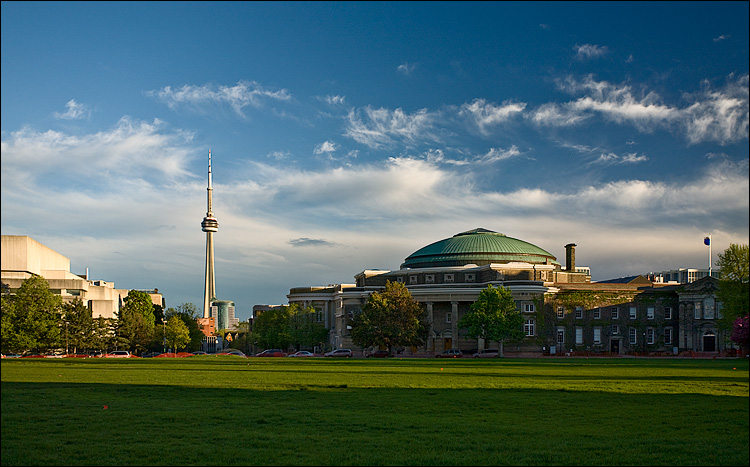
I wish I brought my camera with me today because the city looks amazing in the sunlight. I reflected about Toronto and am discovering new reasons to appreciate the city I was born and raised in.
Toronto has fantastic clutter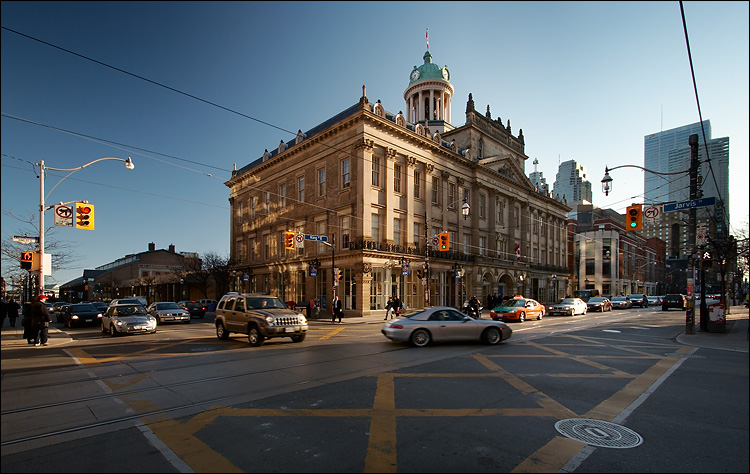
Toronto has an edginess
Toronto has beauty

- "Accepting and inclusive spaces. The city planning department does a good job at encouraging diversity through their neighbourhood projects (like the street signs and business districts).
- Well-preserved heritage buildings. When modern buildings are built around older ones it is always tasteful and appropriate with the architecture.
- Tourism and lots of festivals in the summer, my favourite is PRIDE.
- Cleanliness and aesthetics complete the city. Landscaping is well done and there really isn’t much trash lying around.
- Non-smokers love Toronto. We were one of North America’s more progressive cities in getting anti-smoking legislation passed for public areas."
- "Toronto really does need to improve upon its transit system, it’s embarrassing and a more efficient, cost-effective, and cheaper system is obviously needed. However, the larger problem associated with transit in Toronto is its utilization by the public. It is currently not a viable alternative to car travel, especially for crosstown or regional commutes.
- Additionally the Gardiner must be destroyed and buried by the waterfront similar to what was done in Boston.
- In the inner suburbs like Weston and St. Clair or Leaside, the proliferation of big box stores is a concern. While these are accessible to drivers, they occupy prime real estate in relatively central areas of the city and could have been put to better use."
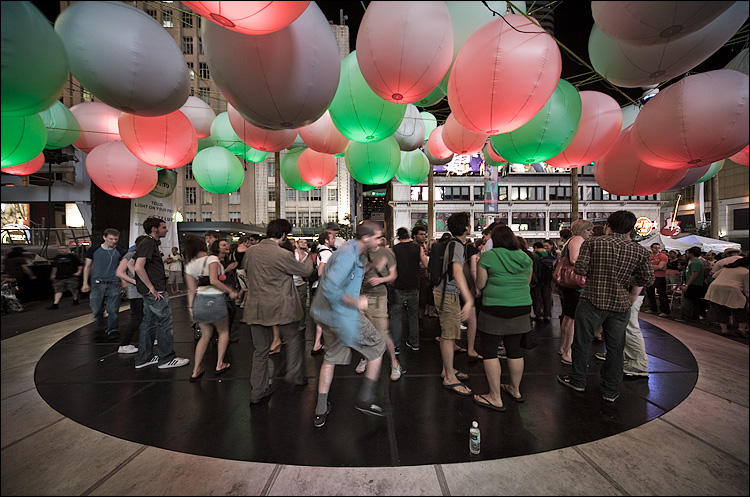 So on my daily TTC commute, it’s nice to look at everyone in the subway car and pause, thinking about how we’re basically all here and getting along. Toronto’s urban condition is therefore perhaps founded in the reality that the city lives, works, and laughs together. It’s a very inclusive space which shouldn’t be taken for granted.